Monday, May 3, 2010

Berlin

Berlin was a lot fun, a lot different from my other trips this semester. Instead of actively sightseeing all day, the group I traveled with was a lot more relaxed so we took time to sleep in, to just walk around and eat, to sit in the park and enjoy the weather, etc. However, we still tried to catch at least the major sites.

The location of the Berlin Wall is demarcated throughout the city and on many tourist maps. The reunification of Germany and the destruction of the wall is a not-so-distant memory that permeates the city. East Berlin, where our hostel was located, is distinctly cheaper than West Berlin so we didn't venture too far into the West. It's interesting how important, culturally and socially, 30 years can be, in terms of splitting the East and the West. Despite the convergence afterwards, some of the distinctions and memories remain between the two halves of the city. Taken from an EU perspective, it may hold an interesting lesson about the importance of historical tradition, the lasting influence of culture and the difficulty they pose in terms of political unification. I'm extrapolating a bit too far, but it is a valid viewpoint.

A section of the East Side Gallery, which as far as I know is the only complete remaining section of the Berlin Wall. This section is covered in different paintings and messages pertaining to Berlin, the Cold War, Communism, etc. It's incredibly inspirational. More than just the political division of East and West Berlin, the Gallery reminds you of the cultural division, the impact on everyday lives, the desolation that entered the city through the destabilizing effects of separate sectors and later sides. The Gallery doesn't project its lessons onto current world crises such as the Middle East, African warfare, etc., but it provides plenty of ammunition to do so.

There's a section of the Gallery where you can write whatever you want with a pen or a marker. Obviously some of the messages were inspirational and life-affirming while others were jokes. One of the joking messages read "Come frutas y verduras". About a foot above it, another person had written " 'Come frutas y verduras'. Palabras immortales" (I eat fruits and vegetables. Immortal words). It made me chuckle.
One of my favorite parts of the East Side Gallery. This picture doesn't do it justice, but the tiny circles have idyllic clouds and sky painted inside them. Juxtaposed with the other parts describing the dire state of Berlin and its people, this part is a perfect reminder about the power of hope. Obviously the same emotion can be found in any survivor story (whether it be Anne Frank or a book I once read about a girl in Kosovo), but I still found it moving.

The Brandenburg Gate, the most obvious symbol of Berlin. Built in 1791, its utility and significance have changed over time. Originally it was one of several gates leading into the city (now the only remaining one). It led into the Unter den Linden, which is still a prominent thoroughfare, to the palace of the Prussian monarchs. In those times only the royal family could pass through the central archway while normal Berliners used the two outermost archways. Eventually the gate was used as a party symbol by the Nazis and made part of the Berlin Wall by the Soviets. When Reagan made his "Mr. Gorbachev, tear down this wall" speech, he made it near this Gate. Evidently, the Gate, especially after German reunification, became a testament to the strength and survival of the nation despite onerous trials.

The Reichstag, the seat of the Bundestag, or the German parliament. Behind this building is a glass dome, which you can walk up in sloping circles to get a good view of the surrounding city. Located only a block from the Brandenburg Gate, this building only came into re-use after German reunification, though it had been used before 1933 for a similar purpose. Entrance and audio guides are free, which I'd definitely recommend. My camera couldn't capture the entire building, but it's quite expansive and impressive.

A poster on the street for the May Day celebration on May 1st. May Day is akin to Labor Day in the States, but it takes on a whole new significance. Wikipedia likens it to International Workers Day, where strong Communist and labour sentiments pour into parades, riots, celebrations, etc. I can't translate the German, but the Communist connection is obvious.

One of the NYU administrators made a good point about Communism. In the States, we completely shun it, using it as a pejorative and not thinking that it has any valid contributions to our political dialogue. Though many European countries don't have Communist governments, the party remains a viable force, a legitimate participant in the political process whose views are heard and reflected in many people's lives. By no means do I favor Communism (after all I go to a business school), but his point resonated with me - that its critiques of capitalism are certainly valid and worthy of attention if we intend to moderate our capitalist system, widen our social safety net, provide a greater welfare state, etc.

The size of the crowd at the May Day celebration. I was weary of the entire affair since I was expecting hard-core Communist political speeches, but it seemed more like several ongoing outdoor rock concerts more than anything else. There were multiple musicians in the nearby streets with the free flow of food (mainly sausages), alcohol, drugs, etc. We stayed in the nearby area for a couple hours (the NYU Berlin housing is nearby), and the celebration was going quite strong well into the evening.

One of the brightly colored subways in Berlin. There's the S-Bahn, which runs overground, and the U-Bahn, which runs underground, but they cover some of the same territory. We paid for tickets twice the entire weekend and rode free every other time. In Berlin and Basel, everyone was lax about the public transportation, and you could easily ride for free (although students from NYU Berlin said they have been checked on occassion). It seems like a minor difference, but I'm wondering if it represents different cultural values. In New York and London, it's hard not to get noticed if you don't pay, but elsewhere in Europe, it's so much easier. It's hard for me to understand why Berlin residents wouldn't call for strict enforcement, through turnstiles or such, so they don't have to subsidize transportation for tourists like me. Unless most people in Berlin don't pay either

The graffiti in Berlin. Some of the graffiti on the ride from the airport was incredible, better than I've ever seen before. Again, this art may be a testament to the nature of East Berlin. Even the East Side Gallery had a bunch of graffiti before it was recently restored.

During the weekend, we also visited a temporary Frida Kahlo exhibit at the Martin Gropius Bau, which had over 120 paintings and drawings. One of my friends is a art history minor so she taught me that Frida Kahlo was the wife of Diego Rivera and one of the only Mexican female artists to be internationally known. Living from 1907 to 1954, Kahlo devoted much of her work to self-portraits and expressions of love, marriage, betrayal, etc. that reflected her own life. The exhibit, which only lasts until August, was fantastic, and I'd highly recommend it.

With its immense amount of history, Berlin is definitely an interesting city. As the capital of arguably the most economically and politically significant country in the EU, I expected it to be a nicer city with great architecture, art, technology, etc. on the scale of Westminster Abbey in London or the Eiffel Tower in Paris. However, I didn't realize how close the memory of the Berlin Wall and the Soviet Union remains to the city. In that sense, I could draw parallels with Istanbul, where so much history had occurred, but the city still felt like it lagged behind its European counterparts. Obviously, that's a simplistic comparison, but I think it gets the point across about why Berlin is so interesting. It makes me want to visit more of Germany and Eastern Europe...I'll have to do it sometime after this semester, I only have two weeks left and Berlin was my last hurrah before finals.

Sunday, April 25, 2010

London Marathon

I volunteered for the Marie Curie cheering station in the London Marathon today. Supposedly, cheering counts for volunteering, who knew? Anyway, it was a ton of fun, a bit like Relay for Life, but without the sleep deprivation.

The only picture I took before my camera died. I was surprised by the scope of the event. Over 30,000 runners participate, and the Tube was packed with their family and spectators alike. They run a roundabout route in the Docklands, ending in the Mall by St. James's Palace.

The costumes of some runners were extravagant. I saw a couple devils, angels, beer bottles, and Buzz Lightyears. One guy had a 15-foot giraffe neck, supported by a backpack. A couple soldiers were running with their military knapsacks. Richard Branson, the founder of the Virgin brand and UK hero, was running with huge, blue butterfly wings. One of the runners was trying to take a picture of Branson with his camera phone as he ran. However, most people were wearing the T-shirt of the charity for which they were raising money. According to Wikipedia, the marathon raised 41.5 million pounds in 2006 for different charities and is the world's largest fundraising event.

I liked the people who had their names on their shirts. It made it easier to cheer for them. Many would reply with a nod or "Thank you". Occasionally, a walker would start running when you yelled "Keep it going, Paul. You're almost there". On the whole, it was an incredibly supportive atmosphere. All the spectators were cheering for somebody, and often, people would yell support to anyone who slowed down to a walk or stopped to stretch their legs. If there was anything about the day that convinced me to run a marathon in the future, it was definitely the supportive atmosphere, which I wasn't expecting for some reason.

I was standing at the 14 and 21.5 mile marks (like I said, the course is roundabout), but I was on the side where the 21.5 mile runners passed me. One of the people next to me kept yelling "Only 15 miles to go, I mean, 5, thank god", which actually drew a few laughs. Whenever I run, I'm in my own world, I don't interact with anyone else, but I was surprised by how interactive the runners were. Some had I-pods on, some were talking on their cell phones (for god knows what reason), but most just had themselves and the road.

On the whole, I loved the marathon and its atmosphere. I've never been to a marathon before, but as someone who ran track, it was an exciting event. I definitely hope to run one in the future, but we'll see how that goes. For now, I'll just stick to the cheering

Wimbledon

Wimbledon was fantastic, and I'd recommend it to any sports fan coming to London. I took the guided tour and visited the museum with an NYU group.

Incredibly Wimbledon, now a private tennis club, started out as a croquet club. Even today, it is officially known as The All England Lawn Tennis and Croquet Club. Our tour guide said it was easier to win the men's or women's singles title than to be accepted as a member of the club. Membership is limited to 500, and you need to show commitment to the advancement of tennis to be voted into the club. However, if you do win the singles title, you automatically become an honorary member. So good luck!

The complex is intended to remind you of an English garden. To that end, there are several benches and tables with many flowers. The Wimbledon colors - green and purple - are speculated to originate from the fact that lavenders were grown in the area of Wimbledon in the early 1900s. However, our tour guide pointed out that those were also the colors of the women's suffragette movement at the time so it may have been a not-so-subtle political statement.

Henman's Hill outside Court 1. During the Championships, an enormous TV is erected by the Wimbledon sign that would nearly span the length of this picture. Therefore, people can sit on the grass, enjoy their ice cream and Pimm's, and watch the tennis. According to our tour guide, champagne and Pimm's (a lemonade drink with fruit inside) are staple alcoholic drinks for the Championships. I never associated tennis with alcohol, but there you go. But then again, the French Suzanne Lenglen used to sip brandy between sets in the early 20th century.

Interestingly, ground admissions passes cost 20 pounds if you wait in the queue. Granted, people start lining up hours beforehand, but from our tour guide's description, Wimbledon truly tries to make its seats affordable. At 3 pm, they resell the tickets for seats where people have left for the day at a reduced rate. Of course, debentures (effectively season passes for five years) for Centre Court will rid you of 27,000 pounds, but there are plenty of other ways to get into Wimbledon.

Centre Court, looking towards the Royal Box. These seats are padded, unlike those in the other show courts, so they're covered when they're not in use. You can also see that the court is covered by a tarp. There are very precise specifications for the height and health of the grass. Apparently it gets cut only one millimeter at a time to prevent damage to the remaining grass.

To the left of the Royal Box, you might be able to see the row of seats for the friends and family of the players. Upon winning the finals, many players jump up there to celebrate with their family. Apparently, in 2008, Nadal jumped up there and ran along the ledge into the Royal Box to hug the members of the Spanish royal family in attendance. Our tour guide joked that no British player would do such a thing. The most Murray can hope for is a handshake. Supposedly the Queen is not a big fan of tennis. The last time she attended a Wimbledon finals was the last time a British woman, Virginia Wade, won the singles title - in 1977.

Court 1. In total, the grounds hold Centre Court and Courts 1 - 19. A few of the 19 are currently being rebuilt so I'm not sure how many will be in use for this year's Championships. Centre Court has always remained in the same location, but the other courts often move. Court 2 was rumored to be cursed since many greats would fall in the first round to no-name players, but it is being rebuilt so many players hope that the curse will be broken.

The yellow sign is part of a fence. Apparently there are many urban foxes in London (although I haven't seen any) who find the courts particularly attractive at night. However, they tend to soil (think toilets) the grass, which is otherwise so carefully maintained. Therefore, an electric fence is erected around Court 1 (and some other courts?) to keep the foxes away. Our tour guide actually said that it's more likely to run into a fox in London than in anywhere else in Britain. I'm not sure why that would be the case.

A statue of Fred Perry, the last male British player to win a Wimbledon title - in 1936. Obviously, the British have a ways to go when it comes to Wimbledon, but to that end, the club sponsors an extensive junior training program. Our tour guide told us that a significant portion of the profit from Wimbledon - something to the tune of millions of pounds after considering TV rights, tickets, official sponsorships, etc. - is donated to charities, one of which sponsors youth tennis. In a few counties in Britain, every student is required to try tennis in their gym class to see who is fit to advance and to be coached by the best instructors in the country. Murray was a product of this system so the British hope to revitalize their caliber of tennis this way.

A list of the official sponsors for the upcoming Championships. Our tour guide was proud of the fact that courts don't have large signs advertising HSBC or Evian. Instead, Wimbledon only has official sponsors, or suppliers. Some suppliers are synonymous with Wimbledon such as Rolex or Slazenger. Every clock in the facilities had golden lettering and framing and was made by Rolex. Slazenger has provided the balls for Wimbledon since its inception in 1877.

Lawn tennis actually has an interesting history. It has several possible predecessors including badminton and royal (or real) tennis. According to our tour guide, royal tennis is similar to handball and is still played by 50,000 people worldwide. However, the first lawn tennis Championships were held in 1877 as a local competition between 20 Brits. In 1922, the Championships were moved a few miles away to the current location of Wimbledon. The private club also owns the golf course across the street, which it must keep as a golf course for another 10 years, but it may convert the land to tennis courts after that point.

The bracket from last year. Each player's name and scores are recorded on the yellow metal slabs. I thought this part was awesome since you could still see Serena Williams and Roger Federer up there. The bracket is located close to the entrance to the complex so it's visible to all.

The list of past winners. It's easy to see that the same people have won for several stretches of time. Billie Jean King and Martina Navratilova are tied with 20 Wimbledon titles, including singles, female doubles, and mixed doubles. This list is located inside the club.

Me sitting in the press room where the tennis players would sit. Apparently there's an extensive interview process after each match. If players don't sit in for their interviews, they can be heavily fined, to the tune of 10,000 pounds. First, the BBC gets a one-on-one interview followed by an interview by the player's national media. Next, each player comes into this room to be interviewed by anyone from the press. Our tour guide said that for players like Federer, this process can take up to five hours (obviously they get 30 minutes to freshen up after their match, but still, very tiring)

If I remember correctly. there are 800 journalists that cover Wimbledon (this figure doesn't include photographers or TV crews). Each stadium has assigned seating for the journalists, dugouts for the photographers on the sides of the court, and commentary boxes for commentaries in different languages. Interestingly, the journalists are ranked so that only 200 have access to the entire facilities from courts to press room to other private areas. The lower-grade journalists may only have access to the courts and press room.

Rafael Nadal's outfit from 2008. I didn't spend too much time in the museum since my friends and I were getting hungry, but it's informative. It has an interesting section on the evolution of tennis fashion. Obviously Fred Perry and LaCoste clothing originated from tennis. Apparently, women used to wear corsets when they played tennis, which severely restricted their range of motion. Thankfully that trend changed to allow for better play.

Pete Sampras's shoes from one of the years that he won Wimbledon.

I'd highly recommend Wimbledon. The atmosphere of greatness, of ambition, of triumph and defeat is infectious, especially once you learn the history. It's also interesting to see how passionately the British enjoy their tennis. Our tour guide said that it would be odd this year since the Championships would occur at the same time as the World Cup and the preparations for the London 2012 Olympics. She was adamant about the fact that no football would be shown in the complex, and she still expected a fair amount of media coverage of the Championships despite the "distractions".

Saturday, April 24, 2010

HOST

Last weekend I went on a two-day trip to Scarborough on the coast of North Yorkshire. The trip was sponsored by NYU and HOST UK, an organization that pairs tourists, especially international ones, with host families for a weekend. At first glance, the arrangement seems sketchy, but HOST does background checks on the families and ensures your safety. Everything worked out well, and the weekend was quite interesting.

I was paired with an elderly couple who have sons in Australia and Leeds, England. However, they host international students, for both weekend visits with HOST and long-term stays for semesters. While I was there, two Spanish boys and two Norwegian boys were in the house. Since the Icelandic volcano blocked all UK flights last weekend, their Chinese daughter, in their words, who is studying in the UK, was delayed in her arrival. Obviously, their service is very interesting, and I haven't heard of anything like it in the States. Even though the couple rarely leaves the UK, the entire world passes through their walls, and they're very much in tune with current events, in a tangible way that few of us can be.

One interesting point that came up in conversation was the relationship between the UK and the US. The husband insisted that tons of Asians passed through his walls, but few Americans came. He couldn't understand this fact in light of the special relationship (In many British people's minds, a special relationship exists between the UK and US. However, I'd never heard of it before I came to the UK). He was right to point out that most Americans never leave the confines of London to enter real England.

The Italian Garden near the southern shores of Scarborough. The several gardens located on the hills were pleasant. On Saturday, my host family pretty much gave me a map and told me to explore. I started on the southern shores and made my way northward.

One of the arcades opposite the beach. I'm not sure what it is about beaches that attracts trashiness (both trashy people and the trashy sides of normal people), but it affects the British as much as Americans. The rest of the town didn't resemble a beach town with cheap restaurants or small summertime houses, but the beach certainly had resemblances of Seaside, NJ. Instead of burgers and fries, there were fish and chips. Instead of dartboards and knock-over-the-moving-target, there were Dave and Buster's-like games in the multiple arcades. Granted, there weren't as many came-straight-from-the-gym-to-show-off-my-muscles kind-of guys, but I'd have to wait until July to get a fair comparison. As you can tell, I was surprised by this atmosphere. However, I guess people are people and cheap, trashy enjoyment is cheap, trashy enjoyment, the world over.

The remains of Scarborough Castle. Originally settled in 370 as a Roman signal station, this piece of land has changed hands many times. It juts into the North Sea and offers a clear view both inland and out to sea. For this reason, it has been prized among kings and rebellious legions. The castle was built in the 12th century, but the three-story keep pictured above was added by Henry II later in the century. If you go to Scarborough, you need to visit the castle, both for its history and its views.

St. Mary's Church from the castle. From that vantage point, it seemed to be the largest church in Scarborough.

Anne Bronte's grave near St. Mary's Church. I actually didn't know who she was at the time, but there was a sign pointing to it so I took a picture. In case you're in my position, she was a British writer of two novels and a volume of poems. Her sister Charlotte wrote Jane Eyre, and her other sister Emily wrote Wuthering Heights (Thank you, Wikipedia). I'm not sure where their graves are, but I'm assuming they're elsewhere since the sign only pointed out Anne's grave.

On Sunday, the husband took me for a drive into the country. For a town with 50,000 residents, it's amazing how close it is to farmland. Traveling into the North Yorkshire moors, he explained that many people hiked for days in this national park, especially come summer.

Rocks in Robin Hood's Bay. On the drive, the husband gave me about an hour to explore the bay while he walked one of his dogs in the hills. The bay was fantastic, even though it's a decent drive from Scarborough. There were some great pictures of the beach, the rocks, the surrounding hills, etc. There were a good number of people walking around, admiring the natural beauty. There was a ton of dried seaweed on the beach, it reminded me of tumbleweed from cartoons.

I found a makeshift staircase cut into one of the surrounding hills. I didn't have too much time to explore, but I climbed the hill. To my left is the fence for one of the farms, and to my right is the beach. Although my camera couldn't really capture the different depths of the beach vs. the hill, it was really quiet and gorgeous up there.

I doubt anyone is going to visit Scarborough, but this post is my attempt to convince you to travel outside London, Edinburgh, Dublin, etc. when you come to the UK. Obviously, there wasn't much to see in the town after two days, but the people I met offered their actual perspectives on Americans, London, government, etc. It's definitely worth a weekend, and I'd highly recommend HOST for the trip.

Wednesday, April 21, 2010

Basel

Let me start off with the journey to Basel. I was flying out of Istanbul to Basel at 3:25 am Friday morning at the end of spring break, while my friends were flying back to London. However, I thought the flight was scheduled for 3:25 pm. I quickly discovered my mistake when I came to the airport at 11:30 am to drop my friends off for their flight. Of course, few people fly from Istanbul to Basel so EasyJet only has one flight on that route each day. I paid 52 euros to get on the next flight and proceeded to wait in the airport for the next 16 hours. Yeah, when you start recognizing the people in the waiting lounges, you know you've been at the airport too long.

Despite the annoying arrival, Basel was a great end to spring break. I only stayed two days until Sunday night so I chose to stay in Basel (where EasyJet flew into) instead of taking a train to Zurich or Geneva. However, a friend who went to Zurich highly recommended it so check it out as well. In comparison to my other spring break cities, Basel was much more quiet, peaceful, and relaxing. It reminded me of a stereotypical well-to-do Connecticut suburb - many well-dressed white people, pleasant springtime weather, and impressive but quiet (in the sense that they weren't hoards of tourists surrounding it) architecture. Granted, I've never been to Connecticut, but there you go.

My hostel was fantastic, probably the best I've had all semester. For 33 francs (which is roughly 30 dollars), I got a clean bed, a huge locker, a clean bathroom, and free Internet. Breakfast cost 9 francs, but I still loved it. It's the YMCA hostel close to the train station, and I also met a few great people.

The Town Hall, or Rathaus. This building is in the middle of a lively square with a farmer's market on Saturdays, Marketplatz. It's the only building of the type, and it's spectacular. Every inch of the exterior is elaborately decorated, not just the front or one tower. I'm not sure if you can go inside since all the signs were in German.

On that note, I was surprised by the lack of English in Basel. Since they're in the corner of Switzerland by both France and Germany, German is the predominant language. Some people spoke a little English, some spoke none, and only the occasional few were fluent. It seemed like more people in Istanbul spoke English than in Basel, which was odd but not too much of a hindrance.

Basel Munster, or the main cathedral in the city. It was free to enter, and the interior was impressive (but nothing special in light of the other churches I saw over spring break). Near the church was a cemetery with the grave of Erasmus, but I could not find it for the life of me. I actually went there twice (since it's close to the center of town) to find him, but no luck.

Spalentor, one of the original city gates for Basel. It's quite a sight with sculptures of odd creatures. Many of the fountains and buildings in Basel seemed to have interesting gargoyles with creatures far weirder than I've seen elsewhere. There were dragons, rabid mice, odd-looking fish, etc. Definitely a trend that I support.

Helvetia, the female personification of Switzerland, or the Helvetic Confederation. This sculpture is located on the Mittlere Bruck bridge near Marketplatz, looking downriver on the Rhine. I really liked the sculpture although I couldn't get a good view of the face due to the morning sun. However, in the afternoon, the banks of the Rhine, especially near this bridge, become packed. It seemed like a great place to hang out like sitting by the Hudson in downtown Manhattan.

One of many public drinking fountains in Basel. I think it's the first city in which I saw such fountains so at first, I was nervous about drinking from it. In fact, this fountain was down a quiet street so I quickly drank from it, not wanting to be seen by the locals in case it was taboo. However, plenty of people (though mainly children) drank from the fountains. I certainly think it's a good idea, especially living in London, where water fountains are nearly impossible to come by, even within buildings.

Basel's Hammering Man sculpture. It forms a part of a series of sculptures in different cities throughout the world, including Seattle, Frankfurt, and Seoul. The cool part is that the arm with the hammer actually moves. The sculpture's located in a random street, and it doesn't even have a base. It just seems to be plopped down near the middle of Basel.

The coolest piece of graffiti I've ever seen. It stretched even wider than my camera could capture in the narrow street. Actually, it may be public art because I can't see how the police wouldn't catch someone who made this art illegally. Nonetheless, it was fantastic.

The Bank of International Settlements. Here comes the Stern side of me, the Basel Accords I and II were written here to establish capital requirements for banks. This Bank has no enforcement mechanisms, but it's a means for central banks to come together and discuss regulatory frameworks in their countries. Central banks then work with national legislatures implement the Accords into law, state by state. I'm not sure what the architecture is supposed to represent. If anyone from the Fed is reading this post, feel free to correct me.

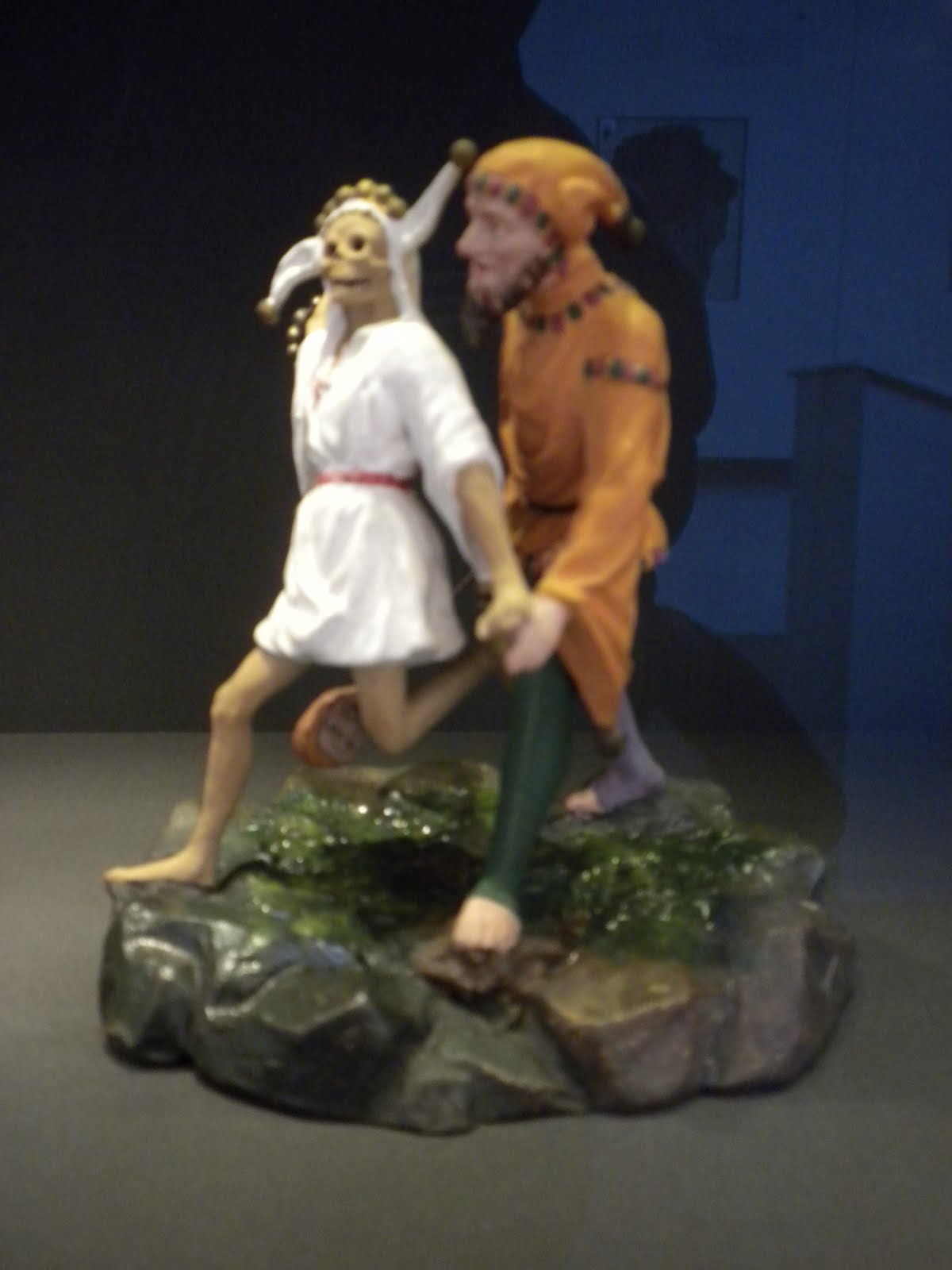
A tiny sculpture from the Historical Museum. There are four buildings in which this museum is located, but I went to the Barfusserkiche one. Barfusserkiche is the center of Basel so this building is the main one, located in an old church. You weren't allowed to take pictures, but I snuck this one in. For the other exhibits, I'd definitely recommend this museum. It has cool tapestries, religious sculptures, and altarpieces. It also gives you an English guidebook, which is key, since all the readings on the exhibits are in German.

A room in the museum was devoted to death and the prominence of it in religion to remind everyone that death is inevitable. One side of the room was filled with tiny sculptures like this one, with death involved with someone from nearly walk of life and profession. They stressed death as the great equalizer, and it reminded me of Dia de los Muertos in Mexican culture.

Basel has many museums. I wanted to check out the Pharmacy Museum, but it was closed on Sunday. Pharmaceutical companies is the reason why Basel became rich, and one of the people I met at the hostel was an American Ph.D student who had followed a chemistry professor from Columbia in New York to Switzerland. In addition to the pharmaceutical companies, I noticed many bank buildings for Ernst & Young, PwC, Credit Suisse, etc.

I also went to the Kunstmuseum, which had great art (again no pictures allowed). Much of the art was from less well-known Swiss and European artists, but there were a few pieces from Picasso and other well-known artists that I forget. However, this museum is worth the visit.

I included this picture because this phenomenon fascinates me. Every city invokes other cities when it comes to fashion, food, or films. For example, New York fashion stores invoke Milan and Paris, leading me to think that those cities wouldn't invoke other cities. However, places like Venice, Paris, and Basel may alternatively invoke New York, in a never-ending cycle. It seems to just be a statement about human nature, where we think the grass is greener on the other side. Nonetheless, this phenomenon is of personal interest, just because I've noted it in each city I've visited.

The food was quite expensive in Basel, which I suppose comes with the high standard of living in Switzerland. Most regular meals, nothing fancy, even for lunch, ranged from 15 to 25 francs. I definitely didn't want to spend 20 dollars on each meal so I ate at a Chinese restaurant (Mr. Wong), a Turkish restaurant (Aladdin), and twice from the supermarket for my two days worth of meals. I don't think I missed out since I'm not sure what Swedish food really is, but just a warning. Even for the chocolate, my hostel owner told me to buy it at a supermarket since it's vastly overpriced in the chocolate shops. In her words, the Swiss eat it there so might as well have the real experience.

On the whole, Basel was peaceful and relaxing. On the first day, I took four self-guided walking tours through the city's hilly streets, and on the second day, I went to a couple museums. I'd recommend the city, but I could easily see some of my friends becoming bored with the city rather quickly. Still looking back, I'm very satisfied with my decision in the Istanbul airport to come to Basel rather than to take a flight home to London.