From the beginning, I thought that the EU would bail out Greece. To that end, I even joked with friends that we should buy Greek debt since the EU would be sure to have it paid. Finance ministers recently announced that the EU would provide Greece with 30 billion euros at a below-market rate of 5%. I didn't think the EU would let the IMF get involved, but the IMF has offered an additional 15 billion euros. Angela Merkel probably wasn't too happy with the EU bailout and paved the way for the IMF to enter the stage.
However, I just read an interesting post on a NY Times blog at http://economix.blogs.nytimes.com/2010/04/15/the-next-global-problem-portugal. A quote from the blog post "While these nations delay, the European Union with its bailout programs — assisted by Jean-Claude Trichet’s European Central Bank — provides financing. The governments issue bonds; European commercial banks buy them and then deposit these at the European Central Bank as collateral for freshly printed money. The bank has become the silent facilitator of profligate spending in the euro zone."
The post argues that there's no reason for EU member states such as Greece, Portugal, or Ireland to be fiscally responsible. They know that the EU, either through the ECB or below-market rate fiscal transfers, will bail them out. The ECB had a means to tighten this loophole by restricting collateral requirements, but it recently made it easier to post sovereign debt as collateral. By using it as collateral, more money is fed into the system, on little to no real basis.
A speaker in our World Studies class said that this crisis will either split apart the EU, through the creation of exit mechanisms for non-performing member states, or will force it closer together, through the creation of more liquid fiscal transfers. At least in the immediate term, it's going down the latter route. Of course, at some point, well-performing member states like Germany will get upset and refuse to stop funding such fiscal transfers. This conclusion, supported by the blog post, says that with the increasing debt, eventually one of the member states will be forced to default, exit the EU, or both. My view is that the EU's bailout of Greece is necessary but that it must either create strict enforcement of the Growth and Stability Pact or be willing to accept fiscal integration to the extent of the US system. I think the former is more likely, but obviously, it's much, much easier said than done. Anyway, I'm not an authority on these matters by any stretch of the imagination, but I just wanted to get my thoughts down. But read the NY Times blog post.
Tuesday, April 20, 2010


Monday, April 19, 2010
Istanbul
I highly recommend this city. It's significantly different - in history, culture, and other aspects - from other European cities so it's well worth a visit. As you know, Istanbul, or formerly Constantinople, was the capital of the Byzantine Empire so in that sense, it's comparable to Rome. However, it has little of the grandeur or the I-know-I'm-the-shit attitude of the Italian cities I visited (granted, I didn't see Rome). It has more of the feel of India, of Mexico, of a rough-and-tumble Third World city still adjusting and re-making itself. Certainly the history isn't lacking, but there's a distinct feeling that you're leaving Europe and approaching the Middle East. Sorry I know this description is bordering on racism, but I think it's the only way to capture the city's atmosphere in words.
To its credit, Istanbul's food was great from the Turkish rice to baklava to the kebab (for which my meat-eating friends can vouch). Make sure you try apple tea and Turkish delight as well. I was joking with my friends, they could put Turkish in front of anything and I would pay twice the price just for the novelty. Granted, the Turkish rice is legitimately different than rice, but just an observation.
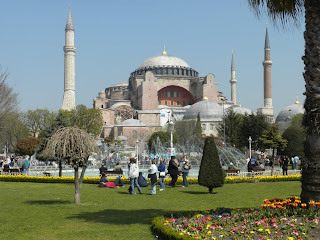 The Hagia Sophia, the first stop on a tourist visit of Istanbul. This building, now a museum, is the quintessential example of this city's unique history. Consecrated in 360 as the cathedral for Constantinople, the capital city for the Eastern Roman Empire, it was converted into a mosque in 1453 when the Ottomans conquered Constantinople. In 1935, the Hagia Sophia was converted into a museum, for which you have to pay 20 euros to enter today.
A note about Istanbul. Even though it's outside the EU, it's not as cheap as you might think. Many prices, especially in the tourist areas, are listed in both Turkish liras (TL) and euros, automatically making them more expensive. Turkey has wanted to enter the EU for decades, but owing to its history and culture, as exemplified in the Hagia Sophia, many Europeans have been weary of this prospect. However, this weariness doesn't stop the Turks from charging much higher prices in euros, at least in Istanbul.
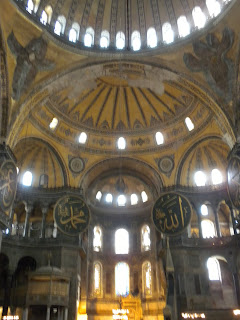 The interior of the Hagia Sophia. The dome structure is a captivating sight. The Catholic mosaics, which were covered up by the Muslims and damaged when they were covered, are noteworthy. The painting of Archangel Gabriel, on the ceiling at the front of the church, is above the mihrab, which is a niche in a mosque wall pointing towards Mecca. Another interesting juxtaposition to see how Gabriel could be incorporated into both religions. Check out the Wish Column, where you rub your thumb in this hole and hopefully feel water as you make your wish. As you can tell, there's plenty to see in the Hagia Sophia, although there aren't as many plaques or readings as you'd expect in a mosque. In fact, I was hoping for more readings to understand the various juxtapositions of religious artifacts.
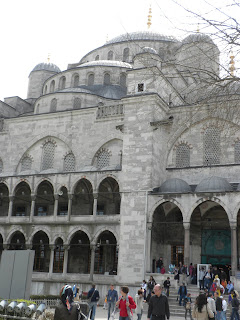 The Blue Mosque, which is still functional as a mosque today. Tourists have a separate entrance where you must take off your shoes and carry them with you in a bag. In comparison to the Hagia Sophia, the mosque is very minimalist. It has similarly impressive domes and wall patterning, but little of the grand furniture, artwork, interior doors, etc. that characterize cathedrals. I think it's the first mosque I've entered, but it clearly reminded me of my temple, and I felt quite at home.
Women are supposed to cover all parts of their body when they enter the mosque. I've heard that, according to Muslim tradition, hair is considered the most attractive part of the body, which is why women are supposed to wear the hijab. Many female tourists adhered to these rules, but several blatantly flaunted them, which I found highly disrespectful. Places of worship should be treated differently than other tourist attractions. Whether it be mosque or cathedral, some people waltz in, flashing their camera at every piece of artwork, marching through with little regard to sound, not giving the slightest regard for those in prayer. Whether or not you're personally offended by the secondary position of women, it is part of the respect owed to the mosque. If you're ideologically offended enough to flaunt the rules, then protest by not visiting.
 A piece of artwork in the Archeological Museum. This complex holds three museums that you can enter for 10 euros, which I recommend. The nearby palace costs 15 euros and is also a sight to see, according to my friends, but I spent all my time in the museums.
The tile museum has interesting pieces and doesn't take too long to complete. The art museum, where this picture was taken, was bland in my opinion. It did have art from over 2000 years ago, which is interesting, but 2000 years ago vs. 3000 years ago doesn't mean much in my head. I stopped caring how old the art was and got a bit bored, which says more about my shallowness than the quality of the museum, but still.
The history museum was overwhelming, but I liked it. There were so many exhibits on four floors that I couldn't possibly get through all of them. However, you learn a ridiculous amount about Turkish history and the various influences that the culture has absorbed. You won't be able to find similar information anywhere else, unless you open a textbook on Turkish history. I recommend spending the majority of your time in the complex in this museum.
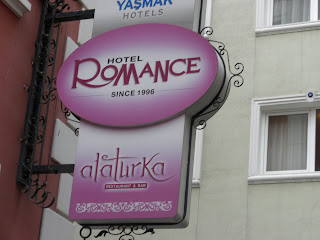 One place I doubt you want to go. No, thankfully, we didn't stay here, but I saw this sign on the street.
 Gate 1 to the Grand Bazaar, which encompasses 4,000 shops and 66 little streets within its covered structure. A major tourist trap, but you have to check it out. The best part is the negotiating. In Istanbul, you can haggle absolutely anything, from merchandise to food to probably hotel rooms (I don't think we tried this one in earnest). The first couple shops you go to, you have to tell yourself that you're going to leave without buying anything, just to get a feel for the haggling. That's your major asset - the ability to leave at any point in the haggling. Once you start walking away, most shop owners will tail you for a few steps, agree to a much lower price, or offer you multiple objects. Especially in the Grand Bazaar, there's probably 20 shops with the same object so a good haggle is if you get it at 40% - 50% of the original price. Obviously, the shop owners calculate this haggling into their pricing so it's your loss if you don't do it. A few owners were legitimately angry at us as they sold us the item at a reduced price. At first, you feel bad, but then you realize you must have gotten a good deal and they would've never sold it to you if they didn't make at least some sort of profit so it's a satisfying feeling.
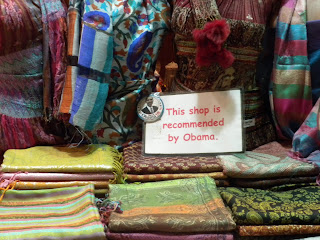 A shop in the Spice Bazaar. I absolutely loved this sign. Either it shows how valuable Obama is as a commercial figure, even halfway across the world, or it shows how many American tourists come to the Spice Bazaar. If you want to buy saffron or other spices for your mom, this bazaar is the place to go.
The man in this shop propositioned the one girl who was in our group, something which happened multiple times when we went shopping. However, the upside of the propositions is that girls can swing a better deal for whatever they buy, as long as they don't get intimidated by the owners' negotiating tactics.
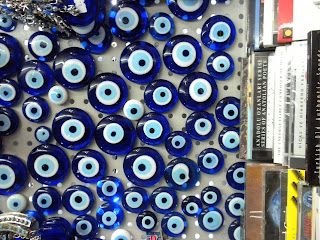 An amulet meant to protect you against the evil eye. You see it all over from earrings to postcards to graffiti since the Turkish are supposed to be very superstitious. Once the amulet breaks, it means that it has protected you against one instance of the evil eye and that you much instantly buy a new one for similar protection. Interestingly, this amulet is known as Nazar, according to Wikipedia. I'm not sure how the word is pronounced, but it's the same word for vision in Gujarati.
 Apparently a gang sign we kept seeing as we walked home from Taksim. Not sure what it means or which gang it belongs to, but I thought it was interesting.
Taksim is the student, nightlife area of Istanbul. There's a main street that runs from Taksim square, which surprisingly had Christmas lights and Santa Clauses running above the streets in April. Like I've hinted, the religious dynamic is interesting. Although a secular state, Turkey allows the Muslim call to prayer to blare from the mosque's minarets five times a day. After all, 99% of its population is Muslim. For me, it's mind-boggling how you balance a secular state, a 99% Muslim population, and Christmas lights in one of the main streets in Istanbul.
 The Bosphorus River, separating Europe from Asia. There is a bridge where you can walk from one continent to the other. We didn't actually walk across the bridge, but we crossed it in a van on our way to/from the airport. We took a six-hour boat ride on the Bosphorus, available from near Sirkeci, for 20 euros. It was a relaxing way to spend our last day, but you can skip it if you're pressed for time.
 The boat ride took us to a hill with picturesque views of the Bosphorus and Asia. Atop the hill/cliff, I especially liked this picture due to the Turkish flag. There's a ruined castle behind me, but you couldn't get into it. However, one of my friends found a stray cat in the fields here. Apparently there's lots of small cats and big dogs walking around Istanbul. At another point in our trip, we saw a stray cat whose tail was freshly chopped off, as in you could see the bright red of the blood on the stub, but we quickly left it to avoid any trouble. Quite gruesome, but otherwise the cats are fine.
I definitely had an enjoyable time in Istanbul and would love to explore other parts of Turkey. Most people don't take too kindly to the fact that you only speak English, but I suppose it's just another part of the social/cultural fabric that I could barely explain to you if asked.
To its credit, Istanbul's food was great from the Turkish rice to baklava to the kebab (for which my meat-eating friends can vouch). Make sure you try apple tea and Turkish delight as well. I was joking with my friends, they could put Turkish in front of anything and I would pay twice the price just for the novelty. Granted, the Turkish rice is legitimately different than rice, but just an observation.
 The Hagia Sophia, the first stop on a tourist visit of Istanbul. This building, now a museum, is the quintessential example of this city's unique history. Consecrated in 360 as the cathedral for Constantinople, the capital city for the Eastern Roman Empire, it was converted into a mosque in 1453 when the Ottomans conquered Constantinople. In 1935, the Hagia Sophia was converted into a museum, for which you have to pay 20 euros to enter today.
A note about Istanbul. Even though it's outside the EU, it's not as cheap as you might think. Many prices, especially in the tourist areas, are listed in both Turkish liras (TL) and euros, automatically making them more expensive. Turkey has wanted to enter the EU for decades, but owing to its history and culture, as exemplified in the Hagia Sophia, many Europeans have been weary of this prospect. However, this weariness doesn't stop the Turks from charging much higher prices in euros, at least in Istanbul.
 The interior of the Hagia Sophia. The dome structure is a captivating sight. The Catholic mosaics, which were covered up by the Muslims and damaged when they were covered, are noteworthy. The painting of Archangel Gabriel, on the ceiling at the front of the church, is above the mihrab, which is a niche in a mosque wall pointing towards Mecca. Another interesting juxtaposition to see how Gabriel could be incorporated into both religions. Check out the Wish Column, where you rub your thumb in this hole and hopefully feel water as you make your wish. As you can tell, there's plenty to see in the Hagia Sophia, although there aren't as many plaques or readings as you'd expect in a mosque. In fact, I was hoping for more readings to understand the various juxtapositions of religious artifacts.
 The Blue Mosque, which is still functional as a mosque today. Tourists have a separate entrance where you must take off your shoes and carry them with you in a bag. In comparison to the Hagia Sophia, the mosque is very minimalist. It has similarly impressive domes and wall patterning, but little of the grand furniture, artwork, interior doors, etc. that characterize cathedrals. I think it's the first mosque I've entered, but it clearly reminded me of my temple, and I felt quite at home.
Women are supposed to cover all parts of their body when they enter the mosque. I've heard that, according to Muslim tradition, hair is considered the most attractive part of the body, which is why women are supposed to wear the hijab. Many female tourists adhered to these rules, but several blatantly flaunted them, which I found highly disrespectful. Places of worship should be treated differently than other tourist attractions. Whether it be mosque or cathedral, some people waltz in, flashing their camera at every piece of artwork, marching through with little regard to sound, not giving the slightest regard for those in prayer. Whether or not you're personally offended by the secondary position of women, it is part of the respect owed to the mosque. If you're ideologically offended enough to flaunt the rules, then protest by not visiting.
 A piece of artwork in the Archeological Museum. This complex holds three museums that you can enter for 10 euros, which I recommend. The nearby palace costs 15 euros and is also a sight to see, according to my friends, but I spent all my time in the museums.
The tile museum has interesting pieces and doesn't take too long to complete. The art museum, where this picture was taken, was bland in my opinion. It did have art from over 2000 years ago, which is interesting, but 2000 years ago vs. 3000 years ago doesn't mean much in my head. I stopped caring how old the art was and got a bit bored, which says more about my shallowness than the quality of the museum, but still.
The history museum was overwhelming, but I liked it. There were so many exhibits on four floors that I couldn't possibly get through all of them. However, you learn a ridiculous amount about Turkish history and the various influences that the culture has absorbed. You won't be able to find similar information anywhere else, unless you open a textbook on Turkish history. I recommend spending the majority of your time in the complex in this museum.
 One place I doubt you want to go. No, thankfully, we didn't stay here, but I saw this sign on the street.
 Gate 1 to the Grand Bazaar, which encompasses 4,000 shops and 66 little streets within its covered structure. A major tourist trap, but you have to check it out. The best part is the negotiating. In Istanbul, you can haggle absolutely anything, from merchandise to food to probably hotel rooms (I don't think we tried this one in earnest). The first couple shops you go to, you have to tell yourself that you're going to leave without buying anything, just to get a feel for the haggling. That's your major asset - the ability to leave at any point in the haggling. Once you start walking away, most shop owners will tail you for a few steps, agree to a much lower price, or offer you multiple objects. Especially in the Grand Bazaar, there's probably 20 shops with the same object so a good haggle is if you get it at 40% - 50% of the original price. Obviously, the shop owners calculate this haggling into their pricing so it's your loss if you don't do it. A few owners were legitimately angry at us as they sold us the item at a reduced price. At first, you feel bad, but then you realize you must have gotten a good deal and they would've never sold it to you if they didn't make at least some sort of profit so it's a satisfying feeling.
 A shop in the Spice Bazaar. I absolutely loved this sign. Either it shows how valuable Obama is as a commercial figure, even halfway across the world, or it shows how many American tourists come to the Spice Bazaar. If you want to buy saffron or other spices for your mom, this bazaar is the place to go.
The man in this shop propositioned the one girl who was in our group, something which happened multiple times when we went shopping. However, the upside of the propositions is that girls can swing a better deal for whatever they buy, as long as they don't get intimidated by the owners' negotiating tactics.
 An amulet meant to protect you against the evil eye. You see it all over from earrings to postcards to graffiti since the Turkish are supposed to be very superstitious. Once the amulet breaks, it means that it has protected you against one instance of the evil eye and that you much instantly buy a new one for similar protection. Interestingly, this amulet is known as Nazar, according to Wikipedia. I'm not sure how the word is pronounced, but it's the same word for vision in Gujarati.
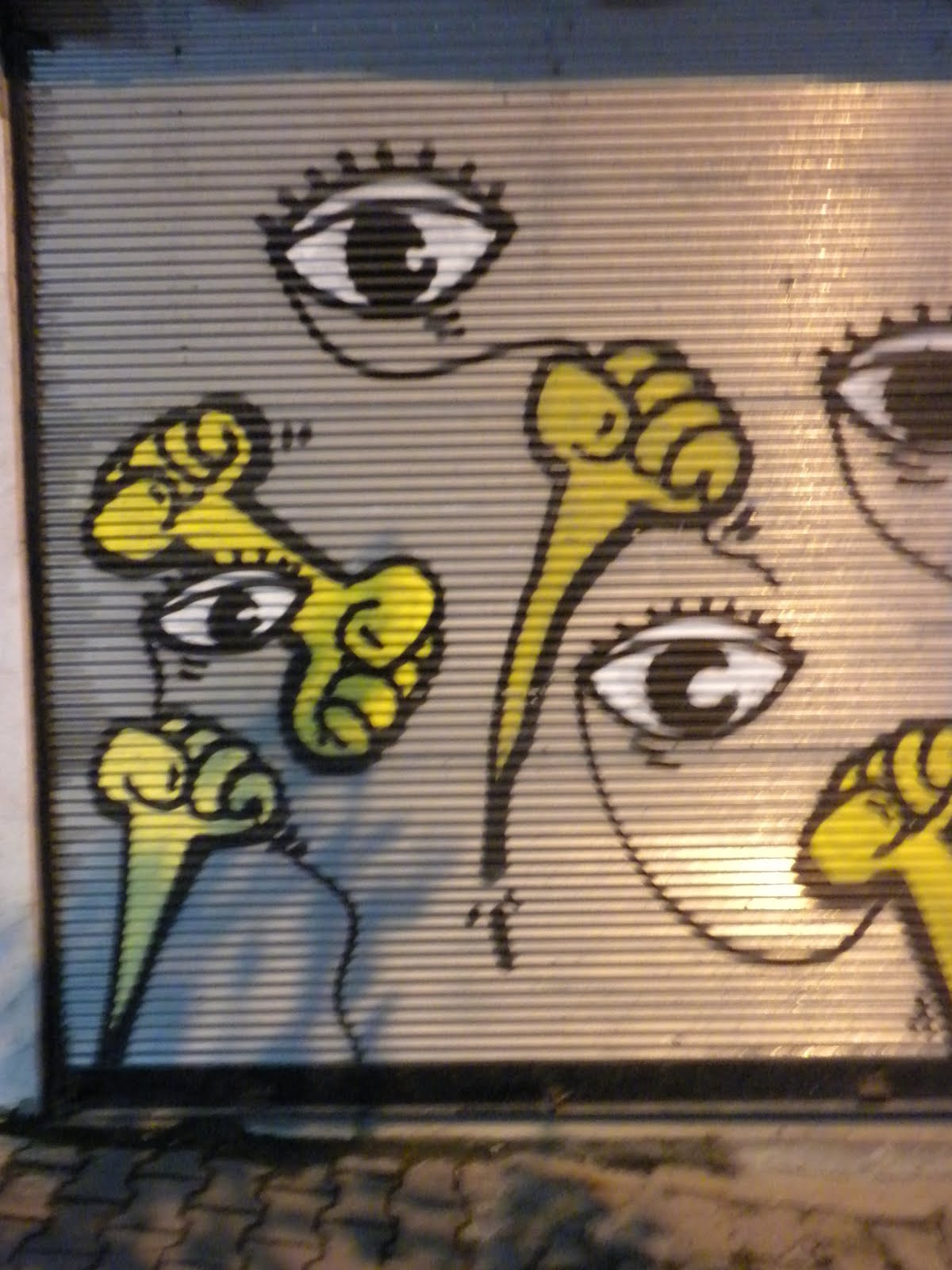 Apparently a gang sign we kept seeing as we walked home from Taksim. Not sure what it means or which gang it belongs to, but I thought it was interesting.
Taksim is the student, nightlife area of Istanbul. There's a main street that runs from Taksim square, which surprisingly had Christmas lights and Santa Clauses running above the streets in April. Like I've hinted, the religious dynamic is interesting. Although a secular state, Turkey allows the Muslim call to prayer to blare from the mosque's minarets five times a day. After all, 99% of its population is Muslim. For me, it's mind-boggling how you balance a secular state, a 99% Muslim population, and Christmas lights in one of the main streets in Istanbul.
 The Bosphorus River, separating Europe from Asia. There is a bridge where you can walk from one continent to the other. We didn't actually walk across the bridge, but we crossed it in a van on our way to/from the airport. We took a six-hour boat ride on the Bosphorus, available from near Sirkeci, for 20 euros. It was a relaxing way to spend our last day, but you can skip it if you're pressed for time.
 The boat ride took us to a hill with picturesque views of the Bosphorus and Asia. Atop the hill/cliff, I especially liked this picture due to the Turkish flag. There's a ruined castle behind me, but you couldn't get into it. However, one of my friends found a stray cat in the fields here. Apparently there's lots of small cats and big dogs walking around Istanbul. At another point in our trip, we saw a stray cat whose tail was freshly chopped off, as in you could see the bright red of the blood on the stub, but we quickly left it to avoid any trouble. Quite gruesome, but otherwise the cats are fine.
I definitely had an enjoyable time in Istanbul and would love to explore other parts of Turkey. Most people don't take too kindly to the fact that you only speak English, but I suppose it's just another part of the social/cultural fabric that I could barely explain to you if asked.
Tuesday, April 13, 2010
Pisa
Don't let them lie to you, there isn't anything more to Pisa than the Tower and the Duomo, at least from a tourist perspective. I spent a day here since my flight was from the Pisa airport. In that time, I walked from one end of the town to the other and back.
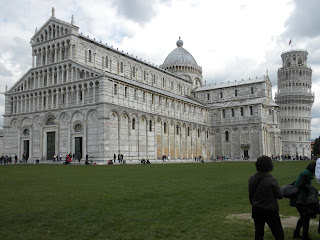 Piazza dei Miracoli, aka Piazza del Duomo. There's a great stretch of grass to the left of this picture where couples were sitting and people were sunbathing. I'm going to make an overgeneralization, but PDA seems to be much more commonplace in Europe. There were a few couples lying on top of each other. Even in London, many couples make out or cuddle while riding the escalators. I usually don't have a problem with it, but it is much more in your face than I remember in the States.
 Yes, it actually does lean. However, I was shocked by how small the tower is. If you count the external rings, there are only seven floors. Each is slightly larger than a normal floor, but the whole tower is smaller than you're led to believe. It costs 15 euros to climb to the top so I skipped the climb. I probably get a better view out of my 20th story dorm in New York.
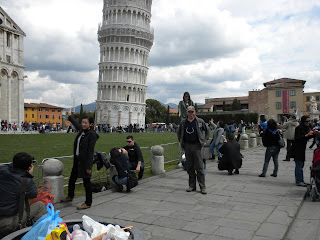 This picture doesn't quite capture it, but there were so many people doing the same pose of holding the tower up. Most people would stand on the little fence posts, but some were original. My friend has a picture of him kicking the tower. The street vendors were selling T-shirts of the tower falling on Bart Simpson. But there have got to be thousands, if not millions, of pictures around the world of people holding the tower up.
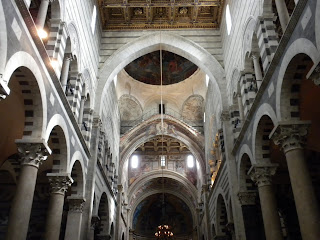 The interior of the Duomo. I was really impressed with the extravagance of this church. The exterior and dome of the Florence Duomo certainly win, but I think the interior of the Pisa Duomo was one of my favorite in Italy. I tried to capture each aspect of it in this picture from the ceiling to the colors of the columns to the paintings in the domes. The walls also have some great artwork (of course, not as great as the Medici church but still pretty high up there).
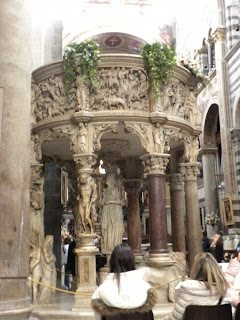 The pulpit inside the Duomo. On the bottom of the solid columns are stone lions holding the columns on their backs. The panels at the top told the story of either Mary or Christ, I can't remember. If you do go to Pisa, make sure you pop into the church for at least 15 minutes. It's probably as astounding as the tower.
Like the Florence square, Piazza dei Miracoli also has a Battistero and Museo dell'Opera in addition to the Campasanto and another museum. This Museo dell'Opera is not nearly as informative as the Florence one.
Outside of this square, Corso Italia and Keith Haring's mural were worth the visit. Corso Italia is a busy shopping street that runs down the southern part of town below the River Arno (the same river that runs through Florence). On this street, there were two women kneeling with a bag in their hand to raise money for leukemia. It was quite a humbling sight, especially since I've never seen it before. Corso Italia will take you to Keith Haring's mural on the side of a church near the train station. If you don't know who he is, Google Image his name and you'll instantly recognize his signature block figures.
Since I was only in the city for one night, I stayed at a camping village just outside the city's northern walls. It wasn't as bad as I expected. Granted, I didn't risk taking a shower there, but we were given trailers with a common room and two bedrooms, each with two beds. I met a boy from North Carolina who is taking a gap year to do organic farming throughout Italy. One of the best parts of traveling on your own (which I did in Pisa and Basel) is the people you meet in hostels or camping villages. I doubt I'll stay in touch with any of them, but it's always nice to meet new people who have completely different outlooks on life. For example, I doubt any of my friends, either in high school or college, considered taking a gap year to do organic farming.
On the whole, Pisa was decent. It paled in comparison to the other Italian cities, but if you have a day before you're flying out from the airport, it makes for a reasonably well-spent day. If you have less than a day, say a few hours, even that may be sufficient. No offense to anyone who's from Pisa lol
 Piazza dei Miracoli, aka Piazza del Duomo. There's a great stretch of grass to the left of this picture where couples were sitting and people were sunbathing. I'm going to make an overgeneralization, but PDA seems to be much more commonplace in Europe. There were a few couples lying on top of each other. Even in London, many couples make out or cuddle while riding the escalators. I usually don't have a problem with it, but it is much more in your face than I remember in the States.
 Yes, it actually does lean. However, I was shocked by how small the tower is. If you count the external rings, there are only seven floors. Each is slightly larger than a normal floor, but the whole tower is smaller than you're led to believe. It costs 15 euros to climb to the top so I skipped the climb. I probably get a better view out of my 20th story dorm in New York.
 This picture doesn't quite capture it, but there were so many people doing the same pose of holding the tower up. Most people would stand on the little fence posts, but some were original. My friend has a picture of him kicking the tower. The street vendors were selling T-shirts of the tower falling on Bart Simpson. But there have got to be thousands, if not millions, of pictures around the world of people holding the tower up.
 The interior of the Duomo. I was really impressed with the extravagance of this church. The exterior and dome of the Florence Duomo certainly win, but I think the interior of the Pisa Duomo was one of my favorite in Italy. I tried to capture each aspect of it in this picture from the ceiling to the colors of the columns to the paintings in the domes. The walls also have some great artwork (of course, not as great as the Medici church but still pretty high up there).
 The pulpit inside the Duomo. On the bottom of the solid columns are stone lions holding the columns on their backs. The panels at the top told the story of either Mary or Christ, I can't remember. If you do go to Pisa, make sure you pop into the church for at least 15 minutes. It's probably as astounding as the tower.
Like the Florence square, Piazza dei Miracoli also has a Battistero and Museo dell'Opera in addition to the Campasanto and another museum. This Museo dell'Opera is not nearly as informative as the Florence one.
Outside of this square, Corso Italia and Keith Haring's mural were worth the visit. Corso Italia is a busy shopping street that runs down the southern part of town below the River Arno (the same river that runs through Florence). On this street, there were two women kneeling with a bag in their hand to raise money for leukemia. It was quite a humbling sight, especially since I've never seen it before. Corso Italia will take you to Keith Haring's mural on the side of a church near the train station. If you don't know who he is, Google Image his name and you'll instantly recognize his signature block figures.
Since I was only in the city for one night, I stayed at a camping village just outside the city's northern walls. It wasn't as bad as I expected. Granted, I didn't risk taking a shower there, but we were given trailers with a common room and two bedrooms, each with two beds. I met a boy from North Carolina who is taking a gap year to do organic farming throughout Italy. One of the best parts of traveling on your own (which I did in Pisa and Basel) is the people you meet in hostels or camping villages. I doubt I'll stay in touch with any of them, but it's always nice to meet new people who have completely different outlooks on life. For example, I doubt any of my friends, either in high school or college, considered taking a gap year to do organic farming.
On the whole, Pisa was decent. It paled in comparison to the other Italian cities, but if you have a day before you're flying out from the airport, it makes for a reasonably well-spent day. If you have less than a day, say a few hours, even that may be sufficient. No offense to anyone who's from Pisa lol
Monday, April 12, 2010
Florence
Probably my favorite city during spring break. I spent four nights living with friends from New York. As expected, I ate loads of pasta and gelato, saw several churches/museums, and walked much of the city several times over. Florence is relatively small in size so it's easy to cover most of it on foot. It's very tourist-y, but I didn't mind since there were still plenty of sites to see. However, my friends said that as a result, they never use any of the Italian they learn since most everyone, including shop owners and waiters, understand English.
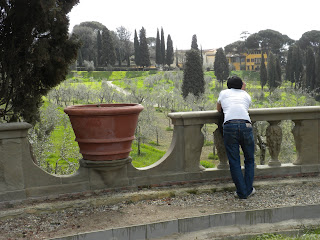 The NYU Florence campus over James's shoulder. I was absolutely stunned when I saw all the grass and trees. You have to understand, coming from NYU, our conception of a campus never includes unencumbered plains of grass where you can just sit and enjoy the beauty. Apparently, it's a donated villa so there are multiple buildings on the sides. It has more of a collegiate feel than NYU, with the campus and with the fact that everyone recognizes each other. As you can tell, I was really impressed and started questioning why I hadn't chosen to study abroad in Florence. The only downside is that the campus is nearly a 45-minute walk from my friends' dorm. It's on the opposite side of the city, but like I said, it's a small city and you can cross much of it in only 45 minutes.
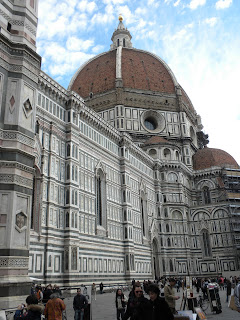 The Duomo, the most obvious sight in Florence. As someone told me, you never need a map in Florence, just figure out where the Duomo and the river are and you'll know where you're going. Officially called Basilica di Santa Maria del Fiore, it is the central church (Duomo) of Florence. So each city has its own Duomo, which took me a while to understand.
Brunelleschi's dome is the largest masonry dome in the world, to this day. You can climb into the dome, but for some reason, it was closed during my visit. If you go to the Museo dell'Opera del Duomo, which is across the square from the Duomo, they have Brunelleschi's working models and his workers' tools. I highly recommend this museum. There is so much art, sculpture, and architecture both outside and inside the Duomo that you need a museum to explain it all to you. Otherwise, it's just a cool big church, but the museum really opened my eyes to the ongoing work to the Duomo over the centuries by Michelangelo, Arnolfo di Cambio, Brunelleschi, Lorenzo Ghiberti, etc.
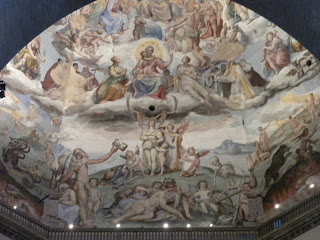 The inside of Brunelleschi's dome. I'm not sure who painted it, but the interior also has many cool paintings and stained glass windows. However, relative to the exterior, the interior is much subdued. As the museum explained it, the donors to the Duomo wanted to display their wealth to the rest of the world, but they didn't need reminders inside their own church. You can also go down into the Duomo's crypt where Brunelleschi is buried. However, it was also closed for some reason. Bad week to come see the Duomo.
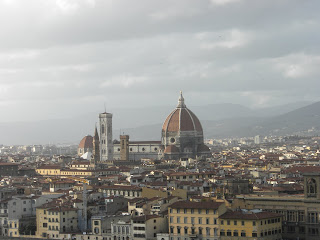 Another view of the Duomo, now from the Piazza del Michelangelo. This piazza was one of my favorite spots in the city. It's a trek to reach there, but the views of the River Arno, Florence, and the nearby mountains are fantastic.
In this picture, you can also see the Clock Tower (Campanile), which is the tall building near the Duomo, and the Baptistry (Battistero di San Giovanni), which is the rounded building next to the Campanile. Both these buildings are in the Piazza del Duomo. Like Piazza San Marco, you can spend your entire day in this square.
The Campanile is supposed to offer amazing views of Brunelleschi's dome and the rest of the city, but the line was too long. If you do want to go up, go early in the morning. Ghiberti's Gates of Paradise adorn the Battistero. Like many other pieces, the ones you see today are copies while the real ones are located in the Museo dell'Opera in order to preserve them. In addition, the sculptures above eye level on both the Campanile and Battistero are noteworthy.
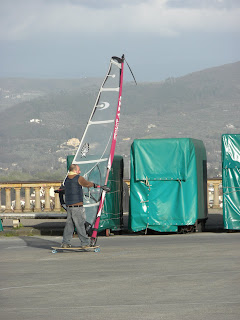 A random person in the Piazza del Michelangelo (We'll take a break from the history for a moment lol). It was quite windy up there so he was actually zooming along in the parking lot. I've never seen this before. Anyone know what it's called?
 The Basilica di San Lorenzo. As you can see, there's no facade, but I really liked the interior (Unfortunately, you're not allowed to take pictures). It has a sharp gray and white pattern between the columns and walls, which I surprisingly liked. This church was the Medici family's parish church so there are incredible paintings and artwork on the walls. Many of the Medici are also buried in this church.
This church is right next to the Leather Market. You could say that all of Italy is a Leather Market, but on the adjacent streets, there are a crazy amount of jackets, bags, shoes, etc. just hanging from flimsy stalls. However, as I was walking by, Lady Gaga was blaring from one of the shops. Wherever you go, you can't escape American pop music.
 The Basilica di Santa Croce. I like this picture because it clearly shows the difference between the marble facade and the wooden church. I didn't realize that the two are separate entities. As you can tell from the Basilica di San Lorenzo, a church can exist without a facade. In the case of the Duomo, the facade can be rebuilt, as it was after di Cambio gave it a shot.
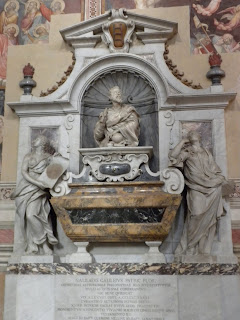 Galileo's tomb in the Basilica di Santa Croce. For me, that was the church's main attraction. Machiavelli, Michelangelo, Ghiberti, and several other figures I didn't recognize are buried in this church. I was slightly disappointed by Brunelleschi's cloister, but definitely check out the Pazzi Chapel and the overwhelming artwork towards the front of the church.
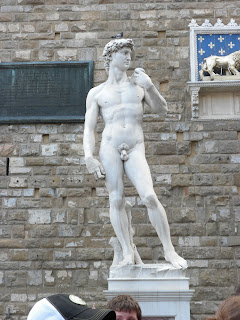 A David outside the Palazzo Vecchio. The real David by Michelangelo is in the Academmia Gallery. I went to the Gallery at noon and the line stretched two blocks so I didn't bother waiting. My guide book recommended reserving tickets for both the Gallery and the Uffizi since they're supposed to be jam-packed with tourists. I didn't get a chance to see either museum, but my friends recommended them.
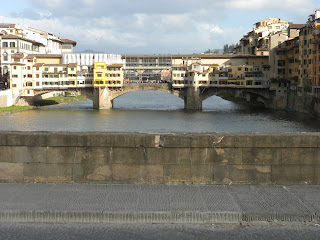 Ponte Vecchio from the next bridge. The Ponte Vecchio has many jewelry and clothing stores on the sides of the bridge. Everyone in Florence asked if I'd seen the bridge, but after you see it once, it loses its novelty.
However, one thing that doesn't lose its novelty is the gelato. I don't even know how many cups I had, but they were all delicious. For one sitting, I had cafe gelato, which is much stronger than the coffee ice cream of the States but is quite good. My advice is to try a different flavor every time you go. Also, a friend said never to go to a place that sells gelato and other things; go to the stores that specialize only in gelato since it has to be good. However, it won't be a problem finding them since there's a store nearly every other block.
Also, the nightlife in Florence was really good. It was the only city over spring break where I really went out, but it was a lot of fun. One of the Florence residents lost his wallet one night, but otherwise everything went well. The drinks can be expensive (London or New York prices), but the nightlife is certainly active even throughout the week. It's funny to see the Duomo deserted at night, especially when it's so crowded during the day.
 The NYU Florence campus over James's shoulder. I was absolutely stunned when I saw all the grass and trees. You have to understand, coming from NYU, our conception of a campus never includes unencumbered plains of grass where you can just sit and enjoy the beauty. Apparently, it's a donated villa so there are multiple buildings on the sides. It has more of a collegiate feel than NYU, with the campus and with the fact that everyone recognizes each other. As you can tell, I was really impressed and started questioning why I hadn't chosen to study abroad in Florence. The only downside is that the campus is nearly a 45-minute walk from my friends' dorm. It's on the opposite side of the city, but like I said, it's a small city and you can cross much of it in only 45 minutes.
 The Duomo, the most obvious sight in Florence. As someone told me, you never need a map in Florence, just figure out where the Duomo and the river are and you'll know where you're going. Officially called Basilica di Santa Maria del Fiore, it is the central church (Duomo) of Florence. So each city has its own Duomo, which took me a while to understand.
Brunelleschi's dome is the largest masonry dome in the world, to this day. You can climb into the dome, but for some reason, it was closed during my visit. If you go to the Museo dell'Opera del Duomo, which is across the square from the Duomo, they have Brunelleschi's working models and his workers' tools. I highly recommend this museum. There is so much art, sculpture, and architecture both outside and inside the Duomo that you need a museum to explain it all to you. Otherwise, it's just a cool big church, but the museum really opened my eyes to the ongoing work to the Duomo over the centuries by Michelangelo, Arnolfo di Cambio, Brunelleschi, Lorenzo Ghiberti, etc.
 The inside of Brunelleschi's dome. I'm not sure who painted it, but the interior also has many cool paintings and stained glass windows. However, relative to the exterior, the interior is much subdued. As the museum explained it, the donors to the Duomo wanted to display their wealth to the rest of the world, but they didn't need reminders inside their own church. You can also go down into the Duomo's crypt where Brunelleschi is buried. However, it was also closed for some reason. Bad week to come see the Duomo.
 Another view of the Duomo, now from the Piazza del Michelangelo. This piazza was one of my favorite spots in the city. It's a trek to reach there, but the views of the River Arno, Florence, and the nearby mountains are fantastic.
In this picture, you can also see the Clock Tower (Campanile), which is the tall building near the Duomo, and the Baptistry (Battistero di San Giovanni), which is the rounded building next to the Campanile. Both these buildings are in the Piazza del Duomo. Like Piazza San Marco, you can spend your entire day in this square.
The Campanile is supposed to offer amazing views of Brunelleschi's dome and the rest of the city, but the line was too long. If you do want to go up, go early in the morning. Ghiberti's Gates of Paradise adorn the Battistero. Like many other pieces, the ones you see today are copies while the real ones are located in the Museo dell'Opera in order to preserve them. In addition, the sculptures above eye level on both the Campanile and Battistero are noteworthy.
 A random person in the Piazza del Michelangelo (We'll take a break from the history for a moment lol). It was quite windy up there so he was actually zooming along in the parking lot. I've never seen this before. Anyone know what it's called?
 The Basilica di San Lorenzo. As you can see, there's no facade, but I really liked the interior (Unfortunately, you're not allowed to take pictures). It has a sharp gray and white pattern between the columns and walls, which I surprisingly liked. This church was the Medici family's parish church so there are incredible paintings and artwork on the walls. Many of the Medici are also buried in this church.
This church is right next to the Leather Market. You could say that all of Italy is a Leather Market, but on the adjacent streets, there are a crazy amount of jackets, bags, shoes, etc. just hanging from flimsy stalls. However, as I was walking by, Lady Gaga was blaring from one of the shops. Wherever you go, you can't escape American pop music.
 The Basilica di Santa Croce. I like this picture because it clearly shows the difference between the marble facade and the wooden church. I didn't realize that the two are separate entities. As you can tell from the Basilica di San Lorenzo, a church can exist without a facade. In the case of the Duomo, the facade can be rebuilt, as it was after di Cambio gave it a shot.
 Galileo's tomb in the Basilica di Santa Croce. For me, that was the church's main attraction. Machiavelli, Michelangelo, Ghiberti, and several other figures I didn't recognize are buried in this church. I was slightly disappointed by Brunelleschi's cloister, but definitely check out the Pazzi Chapel and the overwhelming artwork towards the front of the church.
 A David outside the Palazzo Vecchio. The real David by Michelangelo is in the Academmia Gallery. I went to the Gallery at noon and the line stretched two blocks so I didn't bother waiting. My guide book recommended reserving tickets for both the Gallery and the Uffizi since they're supposed to be jam-packed with tourists. I didn't get a chance to see either museum, but my friends recommended them.
 Ponte Vecchio from the next bridge. The Ponte Vecchio has many jewelry and clothing stores on the sides of the bridge. Everyone in Florence asked if I'd seen the bridge, but after you see it once, it loses its novelty.
However, one thing that doesn't lose its novelty is the gelato. I don't even know how many cups I had, but they were all delicious. For one sitting, I had cafe gelato, which is much stronger than the coffee ice cream of the States but is quite good. My advice is to try a different flavor every time you go. Also, a friend said never to go to a place that sells gelato and other things; go to the stores that specialize only in gelato since it has to be good. However, it won't be a problem finding them since there's a store nearly every other block.
Also, the nightlife in Florence was really good. It was the only city over spring break where I really went out, but it was a lot of fun. One of the Florence residents lost his wallet one night, but otherwise everything went well. The drinks can be expensive (London or New York prices), but the nightlife is certainly active even throughout the week. It's funny to see the Duomo deserted at night, especially when it's so crowded during the day.
Venice
First stop of spring break. Kevin and I landed in the Pisa airport by Sunday morning and reached the Venice train station by Sunday afternoon. The Italian train system is wonderful. You can go to a train station and buy a ticket to anywhere in the country for a train leaving probably in the next hour. However, Italy is bigger than you think (it took nearly three and a half hours from Pisa to Venice in train time).
However, our first taste of Italy came before Venice. We befriended a girl from Chicago who was living with a host family in Florence for a year. She was a vocal critic of the Berlusconi government, citing his reported control of 90% of the national media and the lack of women officials in government. In her words, Italy's a great place to visit, but not so hot to live. I can't comment on the living, but visiting sure was amazing.
 The first scene after Kevin and I put our bags down at our hostel. Before this sunset, we ate at a restaurant with outdoor tables on the water. It was the most peaceful meal I think I've ever had. Light breeze, still water, occasional boat, good pizza, this was certainly the life. We were so jealous of the Italians near us who looked like they did this every weekend.
 As you know, Venice runs on vaporetto, or the boat in the picture. The per-trip charge is high (6.50 euros) so we bought a three-day pass. For us, riding the vaporetto was incredible in itself. On the first night, we just took the vaporetto until we hit a spot we liked, which of course ended up being the tourist-y Rialto. Surprisingly I don't have a picture of Rialto, but it's an easy-to-recognize bridge bustling with restaurants and shops nearby.
 The courtyard of the Doge's Palace. I learned a lot about Venice here, especially its history as a maritime power and the significance of the doge, or the political leader. The Hall of the Great Council is enormous. Apparently, until the 14th century, every male aristocrat participated in Venetian government in this massive hall. Later government officials gained prestige by tracing their roots back to members of this Great Council - basically if you lived in Venice for generations, you had access to greater political power.
 The ceiling leading to the Senate and debating rooms in the Doge's Palace. As you can tell, much of the palace was splendidly decorated. Each doge brought his own herald or symbol so many of the ceilings are covered in different symbols. Also the Bridge of Sighs is noteworthy. The judge's chambers, along with most government functions, were located in the Doge's Palace. Those convicted crossed the Bridge of Sighs into the adjacent building which held the prison cells. You can go into the cells, and it's a wonder that anyone came out of there with their sanity intact. It's dark, cold, and isolated with inch-thick walls of marble. However, as you can guess, with centuries of history and power, the rest of the palace is quite a sight. Definitely recommend.
 The Doge's Palace is located in Piazza San Marco, which is the main tourist square in Venice. St. Mark's Basilica (pictured above), the Clock Tower, a couple art museums, and a couple expensive restaurants comprise the rest of the square. The Basilica has a tower, but save your money and go across the square to the Clock Tower, which is much higher.
 A view of Piazza San Marco from the Clock Tower. This view faces away from St. Mark's Basilica and the Doge's Palace. Note the obnoxiously large LaCoste ad. I couldn't believe that Venice would let LaCoste ruin their main tourist square.
 A view of the rest of the city from the Clock Tower. It's interesting to compare this view with the view of Paris from Notre Dame or the Arc de Triumph. All the roofs have much more color than the ones in Paris.
 A random church. One of the things I loved in Venice, and all of Italy for that matter, was the architecture. You could walk around aimlessly, get lost, and still stumble on an utterly gorgeous building or view. In fact, that's what Kevin and I did for much of the second day after we'd explored Piazza San Marco. We must've creeped some people out since we explored every little alleyway, right up to their homes, but it was well worth it.
We also bought Carnival masks. Watch out for the tourist-y places near Piazza San Marco. We went further upriver and found good masks for 8 euros. It was a major pain making sure they didn't break in my luggage, but hopefully at Halloween, the effort will prove worthwhile. My friends from Florence said they went to Carnival and had a blast. They had to sleep in the train station (which was not a blast), but if you avoid that little inconvenience, I imagine it would be quite fun.
For dinner on the second (and last) night, we met up with a big group of friends. Trying to get home, Kevin and I got utterly lost. Especially at night, the alleyways are so tiny and numerous. The night vaporetto don't run as often so to get to the right station, we spent nearly an hour and a half navigating, getting to an abandoned station, and navigating to Rialto, where more vaporetto run. Yeah, quite scary when you hear footsteps or voices in a random, quiet alleyway, but hey, we made it home safely.
 A final reminder about how gorgeous Venice was (I'm talking about the water, not about Kevin). The weather, the vaporetto, the Clock Tower, the pizza, the Carnival masks all combined to make a great time. You'll notice the history seems a bit drawn out in the Doge's Palace, but even that site was informative and interesting.
Subscribe to:
Posts (Atom)


